

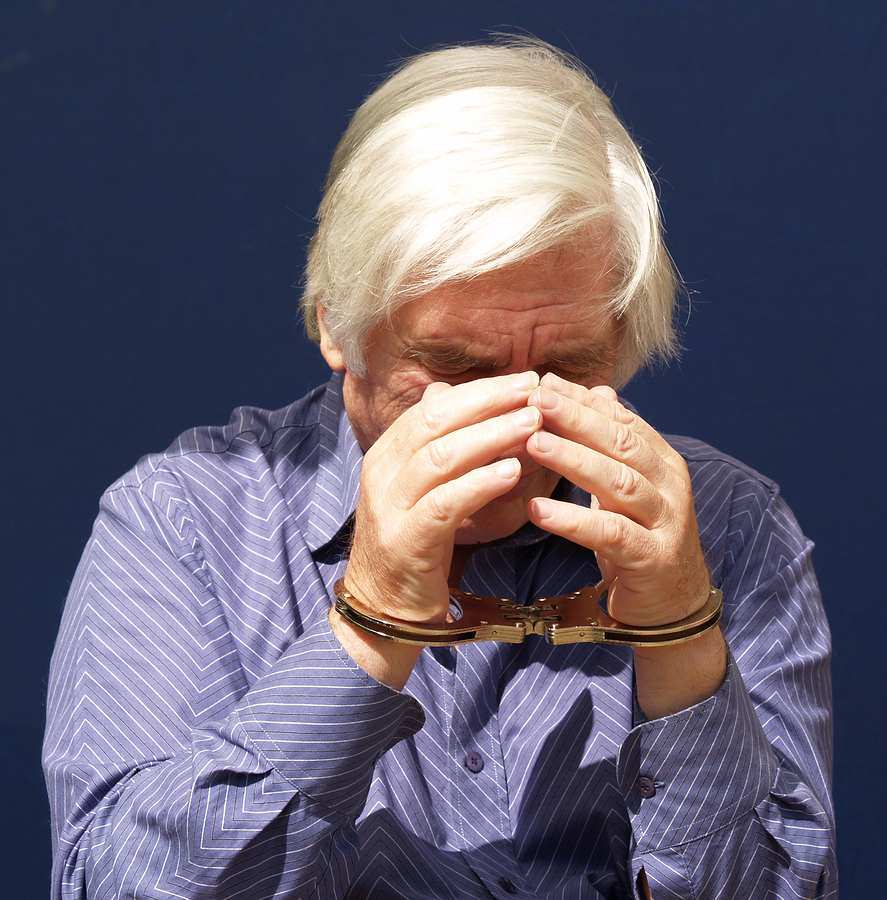
 I want you to imagine for a minute that you have just received some devastating news. I mean some traumatic life changing news that affects you personally and only you. Imagine you are arrested, or that you have been diagnosed with some serious socially stigmatizing disease. Now, in that imagining, I want you to think, what is it that you dread losing because of this trauma. (If we assume that Jesus loves us no matter what and, as St. Paul says, we can never lose God’s love, then this is not an option. So, do not imagine losing God’s love.) Once you have realized what you would lose, you have discovered what you treasure most. This leaves us with what we treasure most and what we most are afraid of losing.
What is not addressed in this exercise is what me may gain. Now, put yourself in the Rich Man’s shoes. Let us pretend that he, indeed, sells all he has and gives to the poor and then he follows Jesus. We can see that he will obviously lose his wealth, but he will lose his reputation, friends, probably members of his family AND his wealth. He will have no one whom he could previously rely on to help him and will have to rely on a bunch of happy strangers whom he sees but he does not know. He will have to live like them in poverty of money and power.
If you were in his position would be able to do this? The rich man can clearly see what he would lose, but he has no idea what he would gain. Yet, such a risk is what Christ is all about. I have a saying that I use quite often with people of faith. Jesus does not give us a job description and ask us what we want to do in working with him. He instead gives us a vocation saying nothing more than “Follow me.” Why? Because if he gave us a job description and told us everything we would experience, we would say “No.”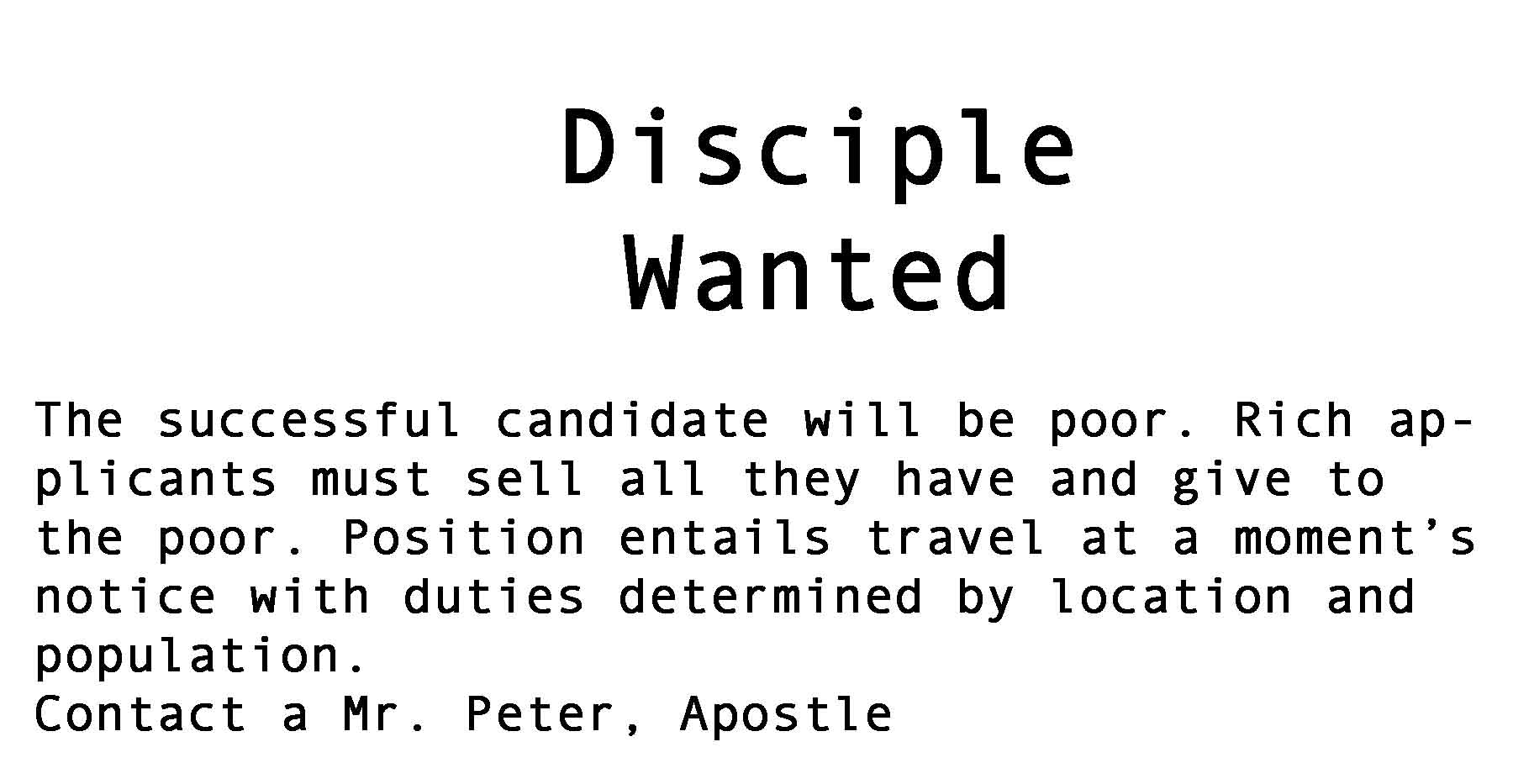
The Rich Man is one of the few people who gets any form of a job description.
The applicant must be poor, rich applicants must sell their belongings and give to the poor. They also must be ready to move immediately to various locations in the area. Living quarters and duties will depend on location. See Peter.
The rich man is not ready to make such a committment. He is so focused on what he may lose instead of what he may gain. What me may lose is virtually certain, what he may gain is too much of an unknown. He cannot trust to that level.
What is the lesson here? I would say from my own experience that when we give our yes to Jesus we can expect anything, but we always look forward to our reward. This requires us to learn to let go of more and more attachments we have here in this life and look further to more and more connection with Jesus and his mission. When we don’t, we find that we are putting our faith in something that promises more than it can deliver.
An example: When I was in Canção Nova (New Song) at Cachoeira Paulista, Brazil; a Frey Josué de Sousa gave a parable of a man holding tight to a rope. It was night time and he had grabbed the rope as security afraid he would fall from where he was. He felt God tell him to slide down the rope, but he could not do that, so great was his fear of losing his life. God then told him to let go of the rope. Again he could not due to his fear. This rope was his security and he felt safe on the rope. Morning came and people found the man dead, frozen from the elements and still holding on to the rope. The sun had risen and now what the man could not see all could see. He was only 2 meters (6 feet) off the ground and had he slid down or let go he would have been safe.
The man in this story is the rich man, unable to let go of what he knows for the power of what he does not know. However, as we all know, no matter how much security we try to promise ourselves from what we know, nothing can guarantee us pure safety. Only in God can we celebrate our true security, but that means we have to leave the notion of any security here. The rich man could not do this.
Is there anything that separates you from saying yes to God. Are there times you can say, Yes, Lord I will follow you wherever you go, as long as you don’t ask me to _____________________________? What happens if he asks you to do whatever is in the blank above?
Notice the rich man. “I seek to be a Holy person. Look at my holiness.” Jesus agrees, but in a sense he says that he is doing all the easy thing. Now he gives him a real challenge.
 One of the 1800’s most fascinating passages is from The Madman by Friedrich Nietzche. If you know anything about the story, it is where Nietzche outlines his philosophy that became the underlying idea for the twentieth century and beyond, even to the present. Many of the century’s problems–and the 20th was the bloodiest of all time–come from this philosophy.
The Madman is about a man carrying a lamp screaming through the town that he seeks God. The townsfolk laugh at him and mock him. It is here that the madman makes the statement that would define Nietzche: “God is dead and we have killed him because we have made him irrelevant in our lives.” God is not dead, but we make Him dead to us, when we make him irrelevant in our lives. God never makes us dead to him in his love for us, by the way.
Those who will accept God’s will on condition ultimately become like the people who mock the Madman. I  will follow you God, but do not take away my wealth. There comes a point that you either have to reject the world or reject God. Only those who can say, “Lord, I will follow you without condition because you love me without condition,” can ultimately fully embrace God. That means that we must suffer as He takes away all those things that separate us from Him and heals our wounds with His salve that lead us to understand His love in new and different ways.
The rich man could not do this. Can You if Jesus asks you? He has you know.
Photocredits:
All but middle top via bigstockphoto.com
Top: Pete Bax
Middle Top: Fr. Robert J Carr (free use allowed)
Middle Bottom: Danez
Bottom: Hubertk